



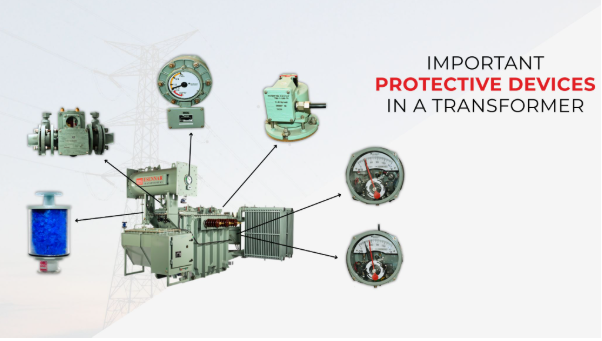
The transformer is one of the most important elements in electrical power systems. Transformers are one of the vital components of electrical power system, especially for voltage regulation and continuous power flow. Transformers are always working in fluctuating electrical and environment conditions and as such they are vulnerable to risks such as overloading, internal fault, overheating, failure of insulation, leakage of oil and short circuit.
Transformers are instrumented with several protection devices to provide early warning of abnormal conditions and activate alarms and shutdowns when needed to assure reliable operation and long service life. Each protective device has a particular purpose in protecting the transformer from electrical, thermal and mechanical stresses.
This is some of the most crucial protective devices found in transformers, and how they help keep the transformer running safely and reliably.
One of the most critical protection devices found on an oil-immersed transformer with a conservator tank is the Buchholz relay.
It is used mostly to sense the internal faults inside the transformer. If the fault occurs, gases from the oil decomposition will be collected in the relay chamber. The relay will then start an alarm or trip the transformer, depending on the severity of the fault.
The Buchholz relay is designed to protect against:
A Pressure Relief Device is used to prevent the transformer tank from excessive internal pressure from severe faults and/or rapid gas generation.
In large internal faults, the internal pressure of the transformer may increase to a dangerous level in the transformer tank. If not released quickly, the tank may rupture or explode. The PRD automatically relieves excess pressure, and prevents mechanical damage.
Key functions include:
The oil in transformers has two important functions: insulation and cooling. Too high oil temperature can reduce the life of insulation and can affect the efficiency of the transformer.
The Oil Temperature Indicator continuously indicates the top oil temperature of the transformer. When the temperature exceeds the safe operating range, alarms or cooling systems are activated and in extreme cases the transformer trips.
The OTI helps in:
The OTI is used to monitor the oil temperature while the Winding Temperature Indicator (WTI) monitors the transformer windings which are usually the hottest part of the transformer.
High winding temperatures may contribute to winding degradation and higher risk of winding failure. The WTI is used to monitor these temperatures and alarms or trips are triggered once the set temperatures are exceeded.
The importance of the WTI is that:
Differential protection is one of the quickest and most effective means of internal fault detection for transformers.
The relay makes a comparison between the current flowing in and out of the transformer. Normally both currents are equal. In the case of an internal fault, the current difference becomes much greater, and the relay opens the transformer very quickly.
Differential protection safeguards against:
Overcurrent protection devices protect transformers against excessive current (overloads or external short circuits).
Earth fault protection detects leakage current to ground in case of breakdown of insulation or contact of the conductor with a grounded object.
These protection systems can help to stop:
Transformers are vulnerable to transient overvoltage occurring due to lightning and switching surge. Such voltage transients can cause insulation damage and lead to catastrophic failures.
Surge arresters are placed close to the windings of transformers to safely ground the extra surge energy before it can damage the windings.
The main benefits of surge arresters include:
The conservator tank is used to allow for expansion and contraction of the oil in an oil-filled transformer.
The Oil Level Indicator is used to check the oil level in the conservator tank and informs the operator if the oil level falls too low.
Low oil level means:
Transformer oil may absorb moisture from air and decrease the oil's insulating properties and cause internal faults. A breather is used to keep moisture out by allowing air to flow through silica gel before reaching the conservator tank.
The breather aids with:
Sudden Pressure Relay systems detect abrupt rises in pressure because of internal faults. Under normal operation pressure builds gradually, but sudden pressure changes indicate abnormal internal conditions.
This device provides:
Magnetic Oil Gauge gives continuous indication of oil level in the conservator tank. It offers visual supervision as well as low and high alarm contacts.
Its functions include:
Protection systems are of paramount importance for ensuring operation safety, reliability and long service life. Every protective device is intended to protect against certain abnormal conditions while reducing the potential for serious equipment damage.
Not only does an effective transformer protection plan avoid expensive failures, but it can also increase system efficiency, decrease downtime and improve the overall reliability of the power network. These protective devices also need to be inspected, tested and maintained regularly to ensure they operate correctly when abnormal conditions occur.
Related Link: THINGS TO NEVER ASSUME WHEN COMPARING TRANSFORMER QUOTATIONS
 Chat with Us