



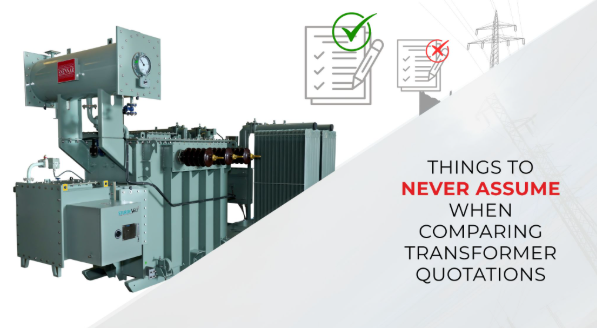
One of the most frequent errors made by the buyer of transformers is to take every quotation as being the same scope, quality and long-term value. Two quotations might look similar on the first look as the kVA rating, voltage class or the price may be similar. Transformers are, however, highly engineered pieces of equipment and even slight specification variations can have significant effects on the efficiency, reliability, operating costs, safety and maintenance costs for the transformer throughout its life.
The lower quotation doesn't necessarily equate to a better price and the higher quotation might contain features that could minimize risks and downtime in the future. That is why transformer quote evaluation should not solely be based on the price. All the technical, commercial and operational aspects must be considered in detail prior to making a purchase.
Below are some of the things you should never assume when comparing quotes for transformers.
Two transformers with identical ratings can still be built very differently internally. These include core material quality, the purity of the conductor, the insulation system, cooling and the winding design.
There are some manufacturers who might concentrate on the initial cost, and others who will be concerned with durability and efficiency.
Key design considerations to consider are:
Failure to pay attention to these details can lead to unexpected failures, increased loss or shortened transformer life.
The lower quote could be for lack of critical accessories, testing, protection systems or after-sales services. Many times, the “cheap” choice will eventually prove to be the “expensive” choice for the following reasons:
Consider the total life cycle cost of the transformer, rather than just the purchase cost. More often, the savings over the equipment's life are much higher with respect to operational efficiency and reliability.
The cost of operating the transformer over many years is directly impacted by the transformer losses. Very small no-load and load losses may generate substantial electricity losses over time.
Always verify:
There may be some quotations that offer a guaranteed loss, or others that might only list an estimated value. This is a very crucial difference. Depending on the losses, a less efficient transformer may cost more at purchase, but can save a lot of money during its life.
A frequent mistake in comparing quotations is that people are not always aware of the various accessories and components that are included in the quotation.
Make sure the quotation is comprehensive and covers all of the following if applicable:
The cost of the project goes up if there are no accessories. If the accessories are not available, the installation process is postponed and the project costs are raised.
Testing is vital to meet safety, reliability and compliance. Not all quotations do contain the same scope of testing.
Some suppliers may choose to only include routine tests, whereas others may include one or more of the following:
Do ensure that standards are followed, including:
Hidden quality risks can only be uncovered after commissioning if there is no documentation of testing.
Any quoted delivery dates should be carefully considered. Some suppliers are offering promising lead times to get orders but it may not be possible in actual manufacturing and logistics.
The factors that influence the delivery are:
Any kind of delay in delivery may have a negative impact on the project while also leading to further financial burden.
After-sales support is often overlooked during quotation comparison, yet it becomes critical once the transformer is installed.
When considering a supplier for a product, check:
A good transformer with poor support can cause significant problems during emergencies.
The terms of a warranty vary from manufacturer to manufacturer. Some suppliers might offer greater protection as they exclude other coverings, and vice-versa.
Always review:
If a failure is discovered, a quotation that has ambiguous warranty language can cause conflicts in the future.
Design of transformers are to be done in consideration of the site environment. It can be expensive if all quotations are not applicable for the same conditions.
Factors that are critical for the environment are:
If the transformer is not designed for the actual operating environment, it may experience early degradation of insulation and failure in cooling.
A brand name company might not necessarily be the most suitable company for a particular application. Each project is different in terms of its technical and operational needs.
Rather than just brand reputation, evaluate:
You want to choose the right transformer supplier, but not necessarily the one you know best.
When it comes to comparing transformer quotes, there's more to it than just looking at their prices and ratings. Each quote is a mix of engineering quality, operational performance, efficiency, reliability, compliance and the long-term support.
The most effective procurement decisions are not made just on the basis of price. Technical evaluation is essential to the most successful procurement decisions. It is important to thoroughly review the specifications, test scope, losses, warranty, accessories and support to help avoid any hidden risks and make better informed investment decisions.
A transformer is an infrastructure asset with a long lifespan. The right comparison process will help to ensure you are cost-effective and are also stable, safe and running for years to come.
Related Link: IMPORTANT PROTECTIVE DEVICES IN A TRANSFORMER
 Chat with Us