



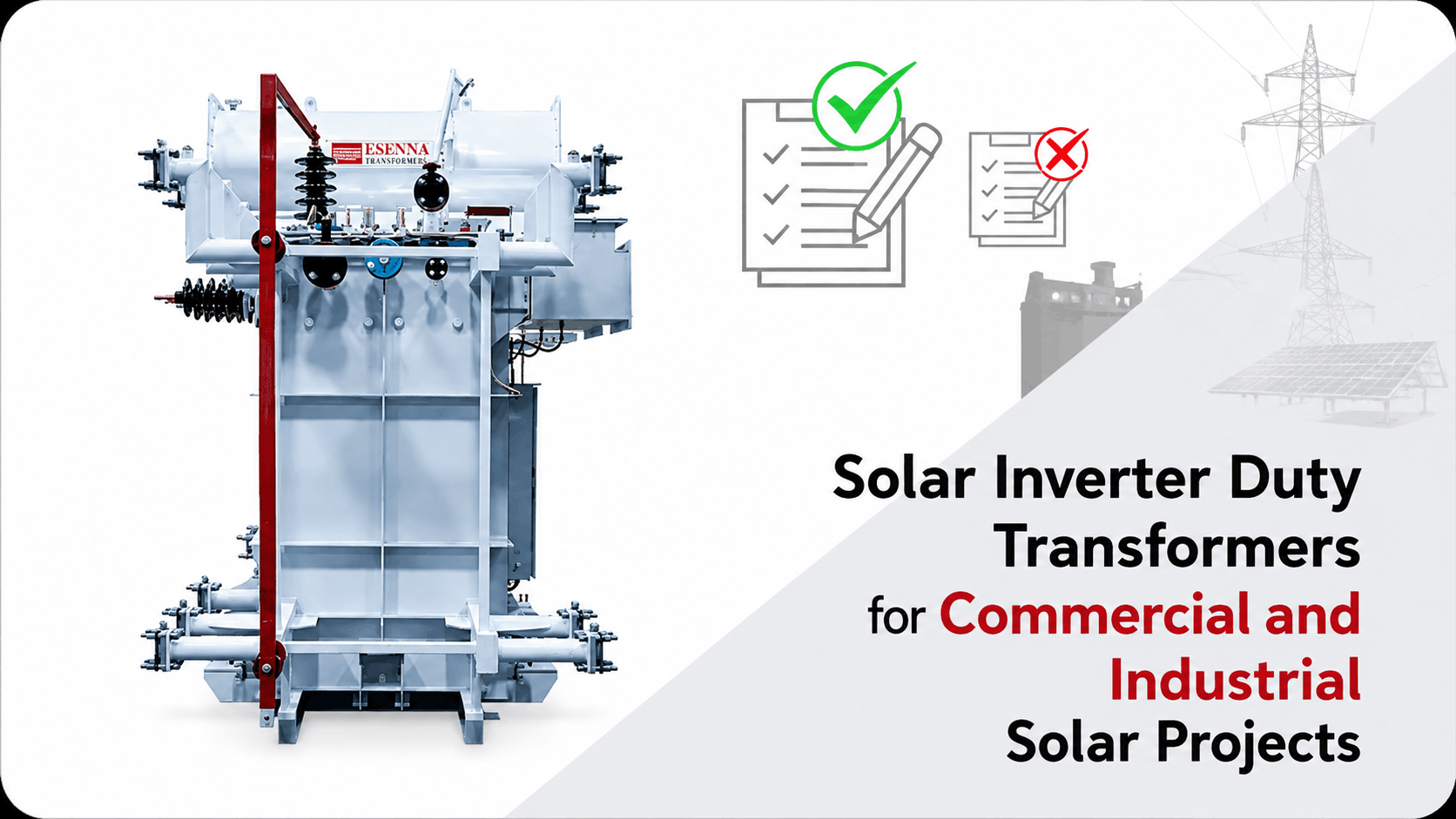
With the continued growth of commercial and industrial solar projects, it's no longer just about solar panels. The performance of the whole power conversion system is equally important. The solar inverter duty transformer is one of the most important part in this system.
This kind of transformer is designed to overcome the problems of photovoltaic systems. It helps to increase voltage, provide isolation, and ensure that the overall process is carried out with the highest levels of safety and reliability.
In this article, we cover everything you need to know about solar inverter duty transformers for commercial and industrial solar installations.
The sinusoidal waveform of solar inverters is not exactly smooth. They have harmonics and switching frequencies and fast load change.
A typical transformer designed only for sinusoidal utility power may experience:
Solar inverter duty transformers are built to handle these conditions.
The primary function of the inverter is to step-up the inverter output voltage to the desired voltage level for transmission or distribution.
Isolation between inverter and grid improves:
These transformers are designed to accommodate the increased harmonic content produced by power electronic converters.
Normally solar inverter duty transformers are installed in:
For any project that involves connection to a medium voltage grid, this kind of transformer is normally required.
The inverter switching generates steep voltage wave fronts. The insulation system shall be able to withstand:
Harmonics increase the eddy current losses in the transformer windings. By properly arranging the conductors and magnetic designs, losses will be kept to a minimum.
Solar generation is not reliable throughout the day. The transformer must address:
When choosing a transformer, the engineers will generally look at:
Inverters switch power devices thousands of times per second. This results in harmonic currents which can generate:
Inverter duty transformers are designed with extra thermal margin and harmonic consideration.
The voltage of the grid changes. Voltage variations can happen on a seasonal and daily basis in a solar plant. Most inverter duty transformers will have either off-circuit or on-load tap changers to adjust the turns ratio to keep the desired output voltage.
Average tap ranges are as follows:
This enables the plant to satisfy the utility's voltage requirements.
All sorts of protection devices are on modern solar transformers.
Protection systems typically consist of:
Such devices can be used to detect early faults and prevent catastrophic failure.
Proper installation is important for the long life of the transformer.
Best practice:
Solar inverter duty transformers are an industrial asset that requires relatively low maintenance.
Routine maintenance schedule:
Monitoring of temperature and dissolved gases is becoming popular in large solar plants for condition based maintenance.
Transformer Undersizing: Inverter nameplate capacity design is not lenient with respect to harmonics and ambient temperature.
Neglecting Ambient Temperature: Indian solar sites are often locations of high temperature. Transformer de-rating might be necessary.
Wrong Selection of Vector Group: Wrong selection of vector group can create synchronization and coordination problems with the protection.
No Future Expansion Included: Many industrial plants add more solar later. By designing for spare capacity from the start, you will reduce your costs for future replacements.
Look for manufacturers that provide:
Solar inverter duty transformers are much more than just step-up transformers. They are designed to cope with the variable fast and harmonic-rich operating conditions caused by modern solar inverters. Their design is oriented towards thermal performance, insulation strength, harmonic tolerance and long term reliability.
The correct inverter duty transformer means higher energy efficiency, less down time, easier grid compliance and a longer lifespan. Users can rest assured that their solar plant will remain safe and efficient for years to come.
Related Link: DISTRIBUTION TRANSFORMER MAINTENANCE TIPS FOR LONG SERVICE LIFE
 Chat with Us