



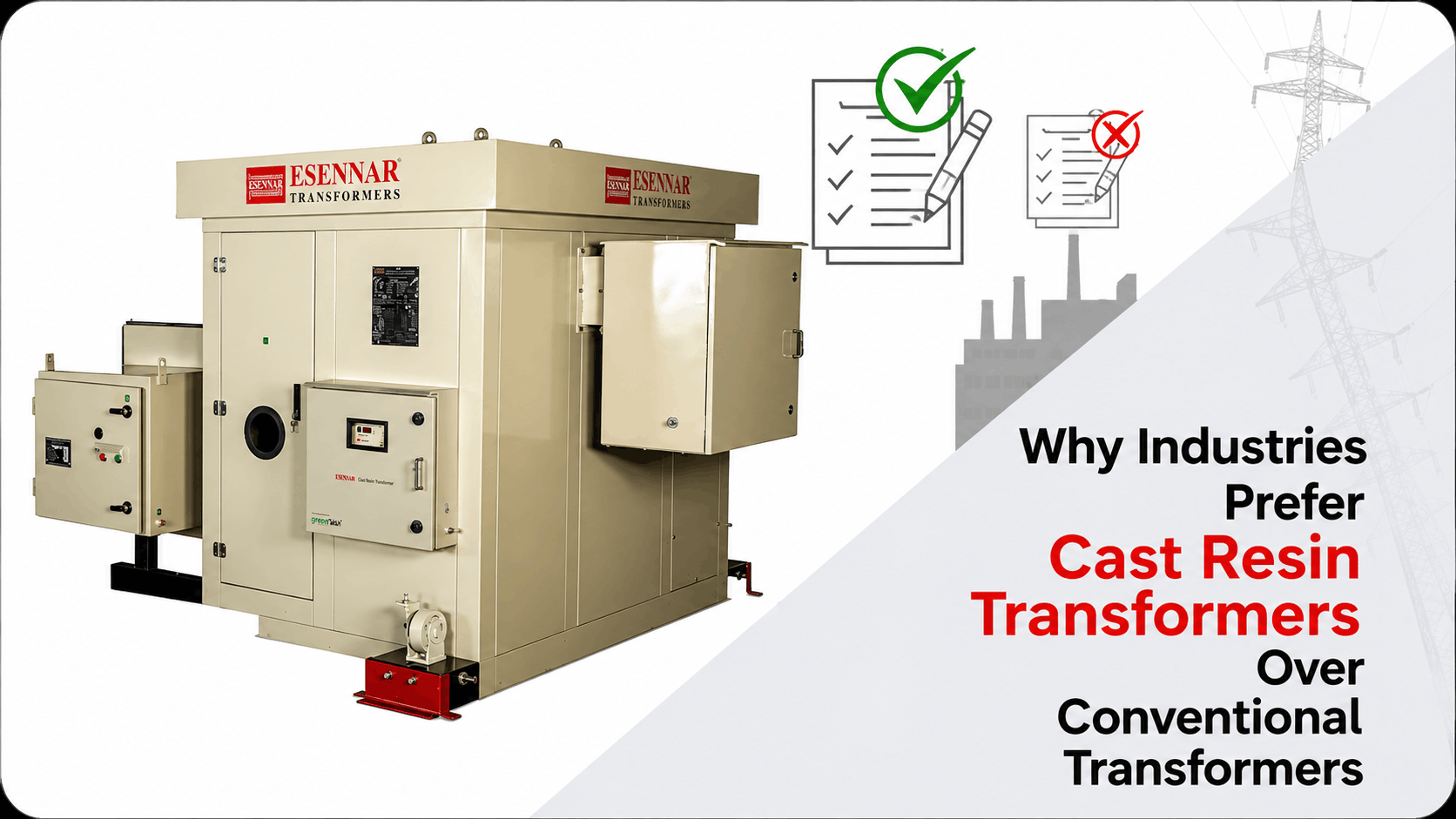
As industries move to modernize their electrical infrastructure, there has been a significant growth in the demand for safer, more efficient and environmentally friendly power solutions. The cast resin transformer has become widely popular among users across industries over the years owing to its versatility and safety.
A cast resin transformer is different from a regular oil-filled transformer as it uses epoxy to protect its windings instead of insulating oil. This design comes with many advantages, making it a highly preferred choice for factories and various commercial buildings.
In this article, we discuss why industries are now opting for cast resin transformers over conventional transformers and what are the advantages of these transformers.
The cast resin transformer is a dry-type transformer that the high-voltage windings are encased in epoxy resin. This insulation protects the transformer from moisture, dust, chemicals and other elements in the environment.
On the other hand, conventional transformers are insulated and cooled with mineral oil. Oil filled transformers are very common for outdoor use and power distribution with high capacity. But they need to be maintained regularly and with added safety measures.
With industries focusing increasingly on operational safety and sustainability, cast resin transformers are becoming the preferred choice for many indoor installations.
One of the biggest reasons why industries choose cast resin transformers is superior fire safety. Since it does not have any insulating oil, the risk of fire is practically none. This makes them particularly suitable for locations where it is necessary to reduce the fire hazard.
Common industries where cast resin transformers are installed are:
The fire-resistant epoxy resin greatly enhances workplace safety, and helps to satisfy stringent building regulations.
Maintenance is an important consideration for all electrical equipment.
Periodic inspections of oil-filled transformers may include:
Many of these maintenance tasks are eliminated with cast resin transformers since they do not use insulating oil.
Routine maintenance usually includes:
Industries around the world are more focused on sustainability than ever before. Cast resin transformers support environmental goals, as they contain no mineral oil which can be environmentally harmful in case of a leak.
Their benefits to the environment are:
Industrial facilities are frequently exposed to extreme conditions, including high humidity, dust, chemicals and temperature variations. This protection improves reliability and allows the transformer to function in a uniform manner even in severe environments.
The epoxy resin encapsulation protects transformer windings from:
Safety is one of the main reasons industries are moving towards dry-type transformers.
Cast resin transformers have some safety advantages:
Their characteristics make them very suitable for facilities with employees, visitors or delicate equipment.
Cast-resin transformers are typically small, making them easy to install indoors without the need for extensive oil containment systems.
There are several advantages to their compact footprint:
Cast resin transformers are constructed to provide many years of reliable service with minimal maintenance.
Their encapsulated windings provide protection:
This leads to fewer unexpected failures and greater operational continuity.
Moisture is often the cause of insulation failure in electrical equipment. The sealed epoxy resin insulation gives very good resistance to humidity. Hence cast resin transformers are suitable for:
They provide consistent electrical insulation performance even in difficult weather conditions.
Noise reduction has been an increasingly important consideration for commercial and industrial facilities. Cast resin transformers are usually designed for lower operating noise levels and as such are suitable for:
Less noise means a more comfortable workplace and helps keep projects in compliance with local noise regulations.
This device is particularly effective in renewable energy projects as it can easily integrate clean energy into the main power grid.
They are used in many areas:
They are long-lived and require little maintenance and are therefore well suited to modern energy applications.
While the initial cost of a cast resin transformer may be higher than a conventional oil-filled transformer, the total cost of ownership is typically lower.
Savings are achieved by:
Higher upfront investment is compensated by long-term savings for many industries.
For their safety, reliability and efficiency cast resin transformers are used in many sectors including:
This versatility makes them ideal for new installations as well as upgradation projects.
The cast resin transformer has become the preferred choice for a great number of industries because it offers safety, reliability and low maintenance in one solution. The epoxy resin insulation protects against moisture, dust and harsh operating conditions, while the oil-free design reduces fire and environmental risks.
With industries focusing on reliable power distribution and long-term cost savings, cast resin transformers are expected to have an even greater role to play in modern electrical infrastructure.
Related Link: TOP POWER TRANSFORMER MANUFACTURERS IN INDIA: WHAT TO LOOK FOR
 Chat with Us