



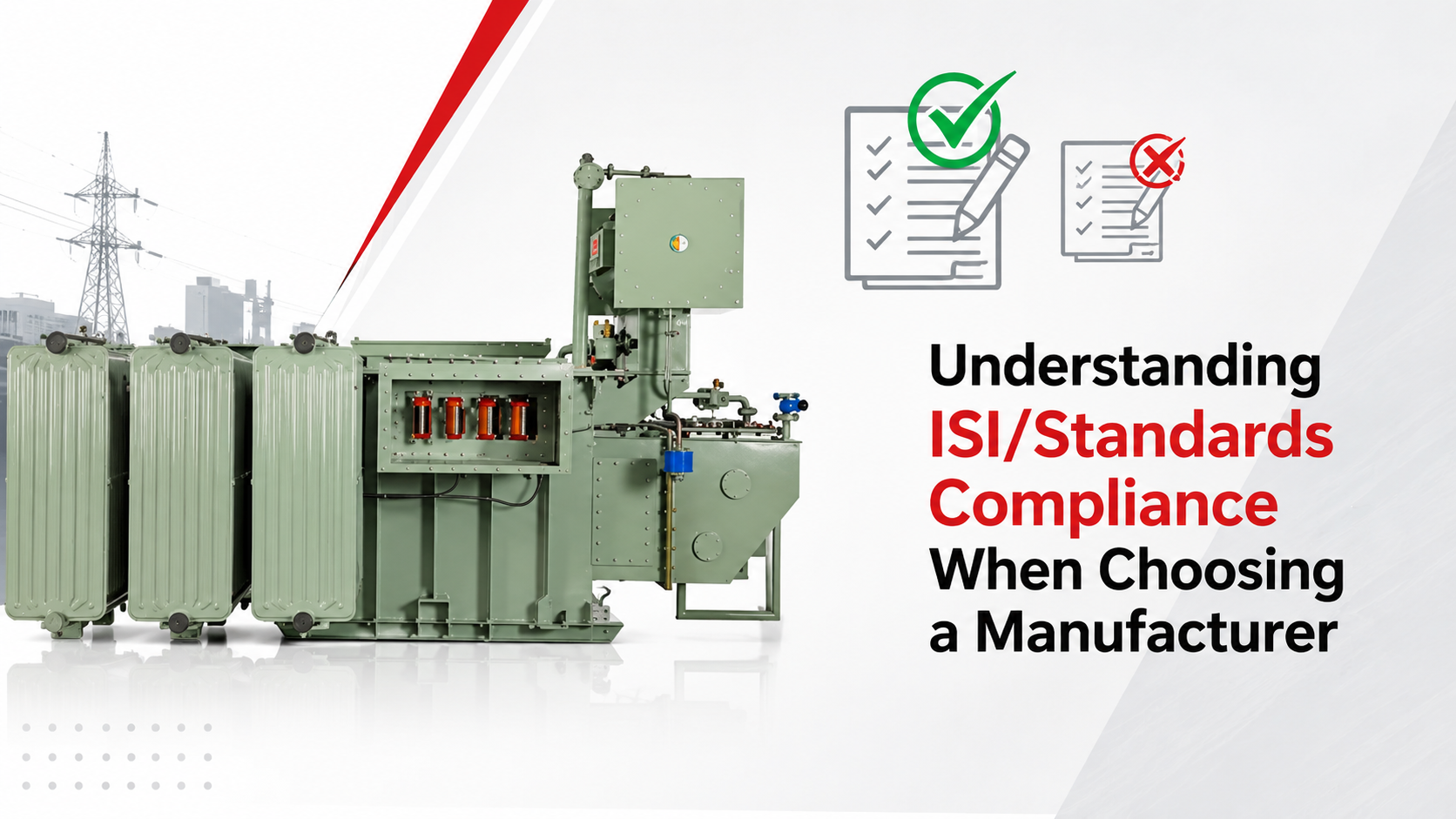
With ever more stringent regulation systems, choosing a transformer manufacturer is not an easy task. Beyond price and product specification comparison, careful consideration of quality, safety, reliability, and industry requirements is essential, and the most important thing is to look for a manufacturer that strictly follows ISI and industry norms.
Standards compliance checks the quality and excellence of manufacturing the parts. It acts as an assurance to buyers that the equipment has been designed, tested, and manufactured to proven standards of safety, efficiency, and performance.
Knowing about ISI certification, as well as other standards, is a way of assessing the quality of the product and assisting industries, utilities, building, and infrastructure projects to choose transformers that will be a good investment.
ISI is the acronym for the Indian Standards Institute, which is now under the control of the Bureau of Indian Standards (BIS). The ISI mark affixed to a product means that the product complies with Indian Standards after passing through strict quality control testing procedures.
Since there were no global standards, the ISI system was introduced to bring uniformity, reliability, and quality assurance in many sectors. As an example of electrical devices, transformers are tested following standards to guarantee the products work as specified in the standard.
A buyer has assurance if the transformer manufacturer adheres to ISI norms as well as BIS specifications.
Transformers are among the most vital electrical assets in a distribution network. Failure can lead to expensive downtime, damage to equipment, process disruption, and safety issues.
Standards compliance helps minimize these risks by ensuring that transformers are:
Compliance makes it easier to decide on procurement decisions, particularly for government, industrial, and infrastructure projects, where regulatory compliance is a must.
There are several Indian Standards for the design, testing, and performance of transformers. Please refer to the overview below to get an idea of the various standards that exist.
IS 2026 is one of the primary standards governing power transformers in the country.
This standard covers:
IS 2026 was designed to give manufacturers a guide for building the most reliable type of power transformer for extreme operating conditions.
Published by the Indian Standards Institute, IS 1180 sets forth the necessary specifications for outdoor oil-immersed distribution transformers.
The standard addresses:
As energy conservation is gaining a lot of prominence, adherence to IS 1180 has become all the more relevant.
Some of the major transformer producers also conform to the regulations set out by the IEC.
IEC standards are internationally recognized and facilitate:
IEC compliance can be a useful advantage for projects that have multinational clients or an export component.
Standards-compliant manufacturers monitor quality control throughout the production process. These measures include:
As a consequence, consumers get a quality product that conforms to defined limits.
Transformer deficiencies pose potential safety issues, such as the risk of fires, electrical hazards, and damage to equipment.
Standards help ensure that transformers incorporate:
This leads to a reduction of operational risk.
Providing a reliable power source is required to run industrial and commercial operations.
Manufacturers that follow recognized standards produce transformers designed to withstand:
This improves the system's reliability and increases uptime.
In many cases, a project needs to be delivered using a system that is fully compliant with all relevant codes and standards.
Choosing a compliant manufacturer simplifies:
This can avoid expensive delays during execution.
A lot of buyers are under the impression that every manufacturer complies with industry standards. The need to check whether this is true arises, influenced by the following factors.
Ask for documentary evidence showing conformity to the applicable standards.
Examples include:
Genuine manufacturers make clear documentation readily available and are also expected to evaluate testing capabilities, since high-quality transformer vendors have advanced test equipment.
Quality standards can be determined from a manufacturer's production capacity.
Consider factors such as:
Established manufacturers generally operate sound production principles.
Compliance is often backed by a strong technical history and operational expertise.
Experienced manufacturers understand:
This assists in maintaining a stable knowledge base that results in uniform product quality and results.
While more affordable options may seem tempting, acquiring equipment from a provider who does not conform to approved standards is undesirable.
Potential risks include:
The long-term costs of using poor-quality equipment can far outweigh the savings made up front.
Procurement of transformers should be seen more as a long-term investment than as a one-off purchase.
Standards-compliant equipment typically offers:
In general, organizations that value quality and compliance tend to earn a higher return on investment on their infrastructure.
At Esennar, quality and standards conformity are never compromised at any step in the manufacturing process. The company is committed to manufacturing transformers that serve stringent industry standards with quality and safety.
We ensure this is achieved through thorough testing, engineering excellence, and the use of industry-recognised standards, enabling Esennar customers to build reliable electrical systems that deliver operational stability into the future.
It is crucial to be familiar with ISI and standards compliance when choosing a transformer manufacturer. The level of compliance is often a good benchmark for quality, safety, and performance, which aids in purchasing decisions.
In addition, a buyer can assess certification, testing, manufacturing procedures, and industry experience to determine whether or not a manufacturer functions to a known standard.
Choosing a reputable manufacturer such as Esennar will result in a transformer designed to provide dependable operation, in accordance with all the necessary standards, and it is a good investment.
Related Link: COMMON CHALLENGES IN POWER TRANSFORMER INSTALLATION AND HOW TO OVERCOME THEM
 Chat with Us