



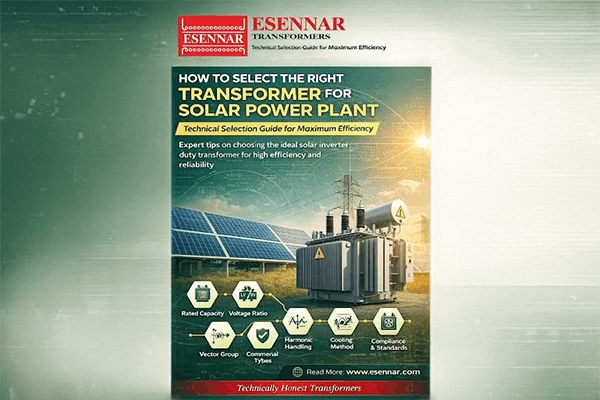
The choice of a transformer suitable for a solar power plant will be very important to provide high efficiency, stable voltage, and operational stability.This is a professional manual that describes the technical specifications, design,variables, the harmonic handling specifications, cooling mechanism, andstandard specifications needed to select the perfect solar inverter duty transformer. Unlike the smaller rooftop projects, utility-scale solar park projects require a large array of transformers, and this guide can be used to ensure that the EPC contractors, consultants, and project developers make informed decisions regarding which transformers they need to employ.
The transformer is an important component in a solar power plant that is powered by photovoltaic because it is used to transmit the energy generated to the grid efficiently. The solar panels generate direct current (DC) that is converted to alternating current (AC) using solar inverters. The inverter output voltage is however usually low and not fit to be transmitted to the grid. A transformer is thus necessary to boost the voltage to medium or high voltage, say 11kV, 22kV, or 33kV so that power can be evacuated efficiently.
When choosing the transformer to be used in a solar plant, it is not only a matter of matching the voltage levels. It entails the knowledge of the load behaviour, harmonic distortion, ambient temperature conditions, the coordination of the impedance, and the efficiency requirements, and the focus on the international standards.
A transformer in a solar plant does not only carry out the vital functions of converting voltage. It guarantees voltage control, electrical isolation, fault level control and stable grid synchronisation. Solar generation is not constant and is dependent on the intensity of irradiance, and, therefore, transformers have to deal with dynamic loads during the day. In contrast to conventional loads inverter-driven systems introduce harmonic currents in the system which must be effectively controlled by specialised design of transformers in the system.
In the case of a large solar park, oil-filled transformers are often utilised since they are highly efficient and have better heat dissipation. Dry-type cast resin transformers are commonly used in commercial or industrial roof top applications due to the safety of fire and low maintenance.
Transformers are selected by the most important parameter which is the rated capacity which is usually in kVA or MVA. Transformer rating should be not less than the total inverter output capacity but slightly more in order to avoid overheating and overloading. Having a safety margin will guarantee some flexibility of the operations and its future scalability.
Another important factor is the voltage rating. The high-voltage side has to be interconnected with the grid at the same voltage as the inverter output, and the low-voltage side must be interconnected with the voltage required by the grid. Even wrong selection of the voltage ratio may result in inefficiency, grid rejection or malfunction of the protection system.
Proper phase displacement and grid synchronisation requires the use of the vector group selection. Widely utilised groups of vectors in solar applications are Dyn11 and YNd11. The proper group of vectors produces parallel working efficiency and prevents the problems of phase diminishing.
The percentage of impedance has a major role in short circuit current and voltage regulation determination. Adequate impedance coordination safeguards the transformer when fault occurs and maintains stabilised voltage output. Choosing the wrong impedance may either cause fault stress or may result in too much voltage drop.
Solar inverters produce harmonic currents, particularly harmonic currents of third, fifth and seventh. These harmonics would result in further heating of transformer windings and core. Harmonic distortion, therefore, can harm the core design product in a solar inverter duty transformer due to reinforced winding insulation and elevated thermal capacity of the product.
It is also vital in terms of thermal management. Transformers in areas with a high temperature like the tropics and the deserts need effective cooling. The distribution transformers are typically cooled by Oil Natural Air Natural (ONAN) cooling, whereas higher capacities are typically cooled by Oil Natural Air Forced (ONAF) cooling.
Transformer losses will have a direct impact on the efficiency of a solar power plant. It has two major losses; core loss and copper loss. Solar plants are in operation over long periods in a day, therefore, any little variation in the values of losses would mean a lot in terms of energy saved during the life of such plants.
Efficiency is achieved by using high-grade CRGO core material, flux density design optimisation and low-resistance copper windings. To achieve compliance with the performance standards and longevity, it would be reasonable to choose a transformer that would be compliant with IEC 60076 or other national standards.
Solar plants are usually situated in inaccessible places that are either dusty, highly humid or subjected to corrosion at the coast. These are the environmental factors that should be taken into account when selecting a transformer. The transformer is safeguarded against environmental decadence by hermetically sealed tanks, anti-corrosive coating, silica gel breathers and high IP-rated enclosures.
The above installations above 1000 metres must undergo derating or design revision because of the lower efficiency of air-cooling. Site condition assessment prior to procurement will avoid failures and performance problems in advance.
The transformers applied in solar plants are required to meet international and regional requirements like IEC 60076, IS 2026, IEEE standards and local electricity authorities requirements. Adherence provides the safety, correct grid synchronisation and regulatory approvals. The grid codes can also specify the voltage regulation requirements, short circuit requirements, and harmonic distortion requirements.
The choice of a transformer company experienced in using transformers in solar working would ensure that these technical and regulatory requirements are met.
In the contemporary solar facilities, renewable energy transformers are required. The solar inverter duty transformers are capable of sustaining elevated ambient temperature, harmonic distortion, and rapid load variation. They are more reliable than standard distribution transformers since they are better insulated, have low impedance, and cool better.
The operation of a standard transformer without a focus on solar-specific parameters may result in its overheating, degradation of insulation, and shortening of service life. Investment in a specially designed transformer to operate with solar energy will therefore guarantee the continuity of energy production and downtime.
Technology matters when selecting a transformer for the solar power plant, which influences its efficacy, dependability, and earnings. Prior to purchase, consider rated capacity, voltage ratio, vector group, impedance, harmonic management, cooling methodology, efficiency elements as well as environmental conditions.
Well-developed transformers reduce losses and stabilise grid integration as well as increasing their lifespan. The solar energy is utilised and depends on technical optimization of a transformer as a utility, commercial, and industrial solar power generation.
Related Link: HOW DO I CALCULATE TRANSFORMER CAPACITY FOR A SOLAR PLANT?
 Chat with Us