



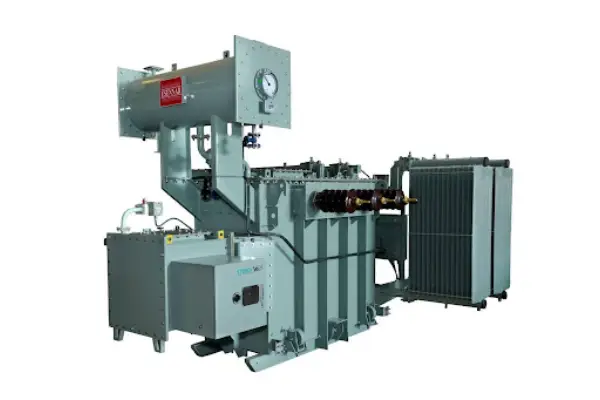
The choice of distribution transformer is one decision that should not be taken lightly by any industrial, commercial or large-scale residential project. A transformer that does not fit can cause inefficiency, high operational costs, early failure and even safety risks. The following guide will detail the most important technical and environmental considerations to make, so that you can have a unit that will provide reliable, efficient, and cost-effective power over the next few years.
The foundation of your selection lies in matching the transformer to your electrical system's core parameters.
Rated Power (kVA): This is the sum of your connected load (in kVA) that you are planning to provide, multiplied by a realistic diversity ratio (not all the loads will be operating at the same time). A transformer should always have a kVA rating 15-20 percent greater than the maximum demand you are going to calculate. This gives it a buffer of future growth and avoids overloading which damages insulation and reduces life cycles.
Voltage Ratings: Spreadsheet and/or voltage requirements: Determine your primary (input) and secondary (output) voltage requirements. The transformer should have an easy time fitting with your incoming supply and deliver the precise utilisation voltage required.
Frequency: Make sure that your transformer is built to the normal frequency in your area. Lack of fit here may lead to serious performance problems.
Vector Group: This determines primary-secondary winding connection and phase displacement. It's essential for parallel transformer operation and earthing/grounding system compatibility. Incorrect vector group selection can cause dangerous circulating currents.
Transformers represent a long-term investment where energy losses have a significant financial impact over a 20–30-year lifespan.
Efficiency and Losses: Consider overall ownership cost, not just purchase price. Transformers have load and no-load losses. No-load losses are much lower in high-efficiency transformers with amorphous metal cores. This matters for long-term low-loading applications.
Impedance: This is a value of the natural resistance of the transformer to fault currents. Lower impedance is more easily voltage regulated under load, but has higher fault currents and may need more robust switchgear. An impedance that is higher will restrict the fault currents but may increase the amount of voltage that drops. This decision should support your fault-level management approach to your system.
Where and how the transformer will be installed dictates its construction type and cooling method.
Indoor vs. Outdoor: Will the unit be in a dedicated electrical room or outside in a yard or on a pad?
Dry-type Transformers: Air or resins are used as insulation. They extinguish themselves, are fireproof and can be installed indoors (offices, hospitals, high-rises, factories) with less toxicity risks and do not require catchment pits.
Liquid-Filled Transformers: Insulation and cooling are done with mineral oil or fluids of lower flammability. They are usually more efficient, higher in life expectancy, and are appropriately used in outside or extreme industrial use. They however need holding systems to the possible fluid leakages.
Cooling Method: Designations like ONAN (Oil Natural, Air Natural) or AN (Air Natural) describe how the transformer dissipates heat. The choice depends on the enclosure type and expected ambient temperature.
Sound Level (dB(A)): In noise-sensitive areas like residential neighbourhoods, hospitals, or urban offices, specify transformers with low sound levels. Dry-types are often quieter, and manufacturers offer "low-noise" designs.
Standards and Certifications: Ensure the transformer complies with all relevant national and international standards for safety, performance, and testing
Accessories: Consider necessary add-ons like On-Load Tap Changer (OLTC) for voltage regulation under fluctuating supply, temperature monitoring devices, protective relays, and surge arrestors.
The selection of the appropriate transformer is a compromise between technological accuracy and long-term thinking. Start with accurate load analysis and systems study. A systematic assessment of the above factors will ensure that you have a transformer that will be the strong, productive, and cost-effective core of your electrical distribution network in the long run.
Related Link: TOP BENEFITS OF USING CAST RESIN TRANSFORMERS IN INDUSTRIAL ENVIRONMENTS
 Chat with Us