



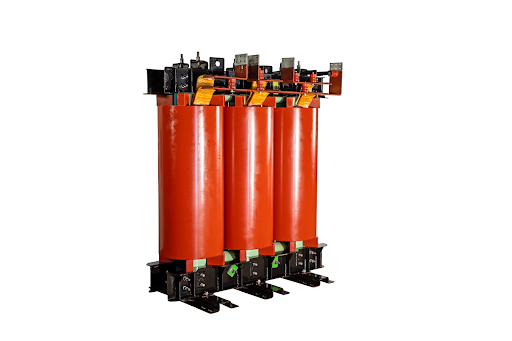
For their excellent safety, dependable operation and greener characteristics, cast resin transformers have become very popular in various fields. Cast resin transformers have solid insulation that allows them to work without using dangerous or polluting coolants which is unlike traditional transformers. This article explains the principles of cast resin transformers and discusses their technology and how they are ideal in today’s power systems.
Cast resin transformers change voltage levels with the help of electromagnetic induction, like any other types of transformers. The thing that makes it different is its insulation: the windings are put into epoxy resin under a vacuum. Because of the solvent insulation, the windings are protected from moisture, dirt and harmful dust which allows the transformer to function reliably in strong conditions and in indoor settings.
Cast resin transformers operations are based on Faraday's Law of Electromagnetic Induction. A transformer usually consists of three key elements, which includes the primary winding, core, and secondary winding.
The primary winding in a transformer acts as a coil and when AC powers it, the changing magnetic field in the core begins to develop. The variation in the number of turns between the coils causes a magnetic flux that induces voltage in the secondary winding. As a result, the transformer can adjust the voltage to suit different applications.
The key feature of a cast resin transformer is that its windings are coated and sealed in epoxy resin. This process is normally performed in a vacuum to make certain that the resin reaches every part and air bubbles are removed. The conductors for cables are usually copper or aluminium and they are wound on insulated cylinders. The windings are put in moulds and filled with epoxy resin under vacuum so that the moisture is removed and no air pockets are created that may lead to partial discharges. After that, the resin is cured by heating it in a controlled way to form a strong and well-insulated shell. Because of this encapsulation, the composite has better strength, conducts heat better and is resistant to different elements in its environment.
Unlike oil-filled transformers that rely on liquid cooling, cast resin transformers are air-cooled through natural air or forced air, which is used to dissipate the heat generated during operation. The design of the transformer allows for efficient heat dissipation via ventilation ducts and surface exposure, often aided by fans in high-load applications.
Core Design: The magnetic core is usually made from high-grade, cold-rolled, grain-oriented silicon steel to minimize core losses. It is laminated to reduce eddy currents and improve efficiency.
Insulation System: Besides the epoxy resin used on windings, insulation spacers, barriers, and varnishes are also applied to prevent electrical breakdowns.
Temperature Monitoring: Built-in temperature sensors or thermal relays are included to monitor winding temperatures. When limits are exceeded, alarms or automatic shutdowns can be triggered.
Ventilation and Housing: Cast resin transformers may be installed in ventilated enclosures to allow for heat dissipation while protecting against mechanical damage or unauthorized access.
Fire Safety: No oil means no risk of flammable leaks or explosions.
Environmental Protection: Resin encapsulation prevents contamination and is safe for indoor use.
Moisture Resistance: Suitable for tropical or humid environments.
Low Maintenance: No need for regular oil testing or replacement.
Compact and Modular: Easier to install in confined spaces such as basements, hospitals, or high-rise buildings.
As energy systems modernise and safety becomes a greater concern, cast resin transformers continue to play an increasingly vital role across commercial, industrial, and renewable energy sectors.
Related Link: APPLICATIONS OF CAST RESIN TRANSFORMERS IN RENEWABLE ENERGY PROJECTS
 Chat with Us