



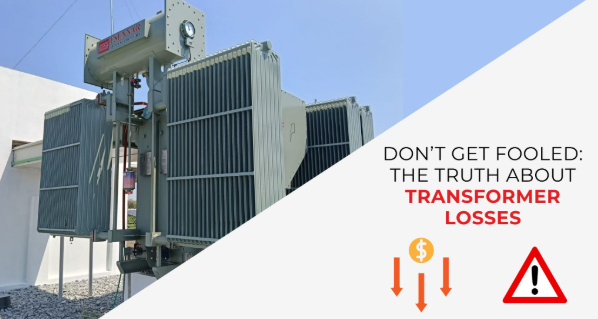
Many people widen their eyes looking at the price tag, kVA rating or delivery date when they are looking to buy or assess a transformer. Those factors are significant but one key factor is often overlooked — transformer losses. What may appear on a datasheet as a minor operational or technical detail could be a major cost, efficiency, reliability or profitability difference in practice.
In most industrial and utility applications, the transformer is in continuous operation. Any minor inefficiency can result in huge quantities of electricity loss over the years of use.
Knowing the facts about transformer losses can lead you to make better investments and prevent unnecessary operating expenses.
Transformer losses are the losses of energy as electrical power traverses a transformer. Installing transformers is never 100% efficient. Some of the electrical energy is always wasted as heat, magnetic leakage and resistance.
These losses are largely in two categories:
As long as the transformer is energized — even no-load — there are no-load losses, also known as core losses or iron losses.
These losses are due to:
The key to understand is that there are no-load losses all the time. These losses are essentially constant both at 10% and 100% loading and while the transformer is in use. Why bad core design can often turn out to be very costly over time.
No-load losses are influenced by:
Each time the transformer is providing power to connected equipment, load losses occur. These losses are primarily due to electrical resistance of the windings. Load losses are much higher as the flow increases.
In simple terms:
The load losses are influenced by:
Copper windings should result in lower losses than aluminum windings, and sometimes are more expensive.
The most common mistake made when purchasing transformers is thinking that the cheapest transformer is the best.
Actually, cheaper transformers often compensate for their reduced cost by:
This can lower production expenses but will increase energy losses during the transformer's lifespan. Additional lost electricity costs over a number of years can be greater than the savings made in the initial purchase.
Many buyers overestimate the amount of money transformer losses are to them annually.
Think about this: A transformer is working for years and years, even decades. Add a few kilowatts of additional losses (24/7) and you have significant electric costs.
Transformer losses impact:
Transformer efficiency numbers are frequently given as:
On the surface, these numbers look very similar. But, the savings in energy over time for a 98% efficiency as opposed to a 99.5% efficiency can be vast.
In particular for:
There is one common error that buyers make, they assume all the quoted loss figures are guaranteed.
Some quotations might contain:
Guaranteed losses are losses that are agreed upon in a contract and are guaranteed during testing. They offer a much more robust protection to the buyer.
Always verify:
A transformer's losses are greatly influenced by temperature.
As the transformer's temperature increases:
Therefore the selection of transformer must take into account:
Energy efficiency regulations and standards are becoming increasingly applicable to modern transformers.
These standards are devoted to minimizing:
When making comparisons between transformers, look at compliance to standards. Transformers that do not meet these requirements may seem cost effective at first, but may lead to a higher operating expense and potential regulatory problems.
Some transformers are not used at full capacity all the time. Some have only partial loading conditions throughout their lives.
At low loads:
At high loads:
A transformer which is optimized for only full-load service can be suboptimal under actual operating conditions. The correct type of transformer for a job depends on the actual load profile on an application.
There are some common pitfalls that many buyers tend to step into when considering transformer losses.
Never assume:
A lot of people do not understand how important transformer losses are. Even though they are small numbers on a specification sheet, they have a big impact on the costs, dependability, and life of equipment for many years.
The actual expense of a transformer is no longer the cost of the transformer itself but the total cost of all of the energy losses over its life. No-load losses, load losses, efficiency ratings, guaranteed values and lifecycle costs are all measures that can help the buyer make a smarter purchasing decision and avoid costly mistakes.
Related Link: THE WRONG CHECKLIST: HIDDEN RISKS BUYERS IGNORE BEFORE ORDERING A TRANSFORMER
 Chat with Us